(a term that derives from "popular") is a genre of popular music that originated in its modern form in the Western world during the 1950s and 1960s, deriving from rock and roll. The terms "popular music" and "pop music" are often used interchangeably, although the former describes all music that is popular (and can include any style). Pop music is eclectic, and often borrows elements from other styles such as urban, dance, rock, Latin, and country; nonetheless, there are core elements that define pop music. Identifying factors include generally short to medium-length songs written in a basic format (often the verse-chorus structure) as well as the common employment of repeated choruses, melodic tunes, and hooks. Definitions[edit] David Hatch and Stephen Millward define pop music as "a body of music which is distinguishable from popular, jazz, and folk musics".

According to Pete Seeger, pop music is "professional music which draws upon both folk music and fine arts music".[2] Although pop music is seen as just the singles charts, it is not the sum of all chart music. The music charts contain songs from a variety of sources, including classical, jazz, rock, and novelty songs. Pop music, as a genre, is seen as existing and developing separately.
Thus "pop music" may be used to describe a distinct genre, aimed at a youth market, often characterized as a softer alternative to rock and roll. v Etymology[edit] The Oxford Dictionary of Music states that the term "pop" refers to music performed by such artists as the Rolling Stones (pictured here in a 2006 performance) The term "pop song" was first recorded as being used in 1926, in the sense of a piece of music "having popular appeal".Hatch and Millward indicate that many events in the history of recording in the 1920s can be seen as the birth of the modern pop music industry, including in country, blues and hillbilly music. According to the website of The New Grove Dictionary of Music and Musicians, called Grove Music Online, the term "pop music" "originated in Britain in the mid-1950s as a description for rock and roll and the new youth music styles that it influenced ...". The Oxford Dictionary of Music states that while pop's "earlier meaning meant concerts appealing to a wide audience ... since the late 1950s, however, pop has had the special meaning of non-classical mus[ic], usually in the form of songs, performed by such artists as the Beatles, the Rolling Stones, ABBA, etc". Grove Music Online also states that "... in the early 1960s [the term] 'pop music' competed terminologically with Beat music [in England], while in the USA its coverage overlapped (as it still does) with that of 'rock and roll'".
From about 1967 the term was increasingly used in opposition to the term rock music, a division that gave generic significance to both terms.Whereas rock aspired to authenticity and an expansion of the possibilities of popular music, pop was more commercial, ephemeral and accessible. According to Simon Frith pop music is produced "as a matter of enterprise not art", is "designed to appeal to everyone" and "doesn't come from any particular place or mark off any particular taste". It is "not driven by any significant ambition except profit and commercial reward ... and, in musical terms, it is essentially conservative". It is, "provided from on high (by record companies, radio programmers and concert promoters) rather than being made from below ... Pop is not a do-it-yourself music but is professionally produced and packaged". Influences and development[edit] The story of pop music is largely the story of the intertwining pop culture of the United States and the United Kingdom in the postwar era. “” — Bob Stanley Throughout its development, pop music has absorbed influences from most other genres of popular music.

Early pop music drew on the sentimental ballad for its form, gained its use of vocal harmonies from gospel and soul music, instrumentation from jazz, country, and rock music, orchestration from classical music, tempo from dance music, backing from electronic music, rhythmic elements from hip-hop music, and has recently appropriated spoken passages from rap. It has also made use of technological innovation. In the 1940s improved microphone design allowed a more intimate singing style and ten or twenty years later inexpensive and more durable 45 r.p.m. records for singles "revolutionized the manner in which pop has been disseminated" and helped to move pop music to 'a record/radio/film star system'.Another technological change was the widespread availability of television in the 1950s; with televised performances, "pop stars had to have a visual presence".In the 1960s, the introduction of inexpensive, portable transistor radios meant that teenagers could listen to music outside of the home. Multi-track recording (from the 1960s); and digital sampling (from the 1980s) have also been utilized as methods for the creation and elaboration of pop music. By the early 1980s, the promotion of pop music had been greatly affected by the rise of Music Television channels like MTV, which "favoured those artists such as Michael Jackson and Madonna who had a strong visual appeal".
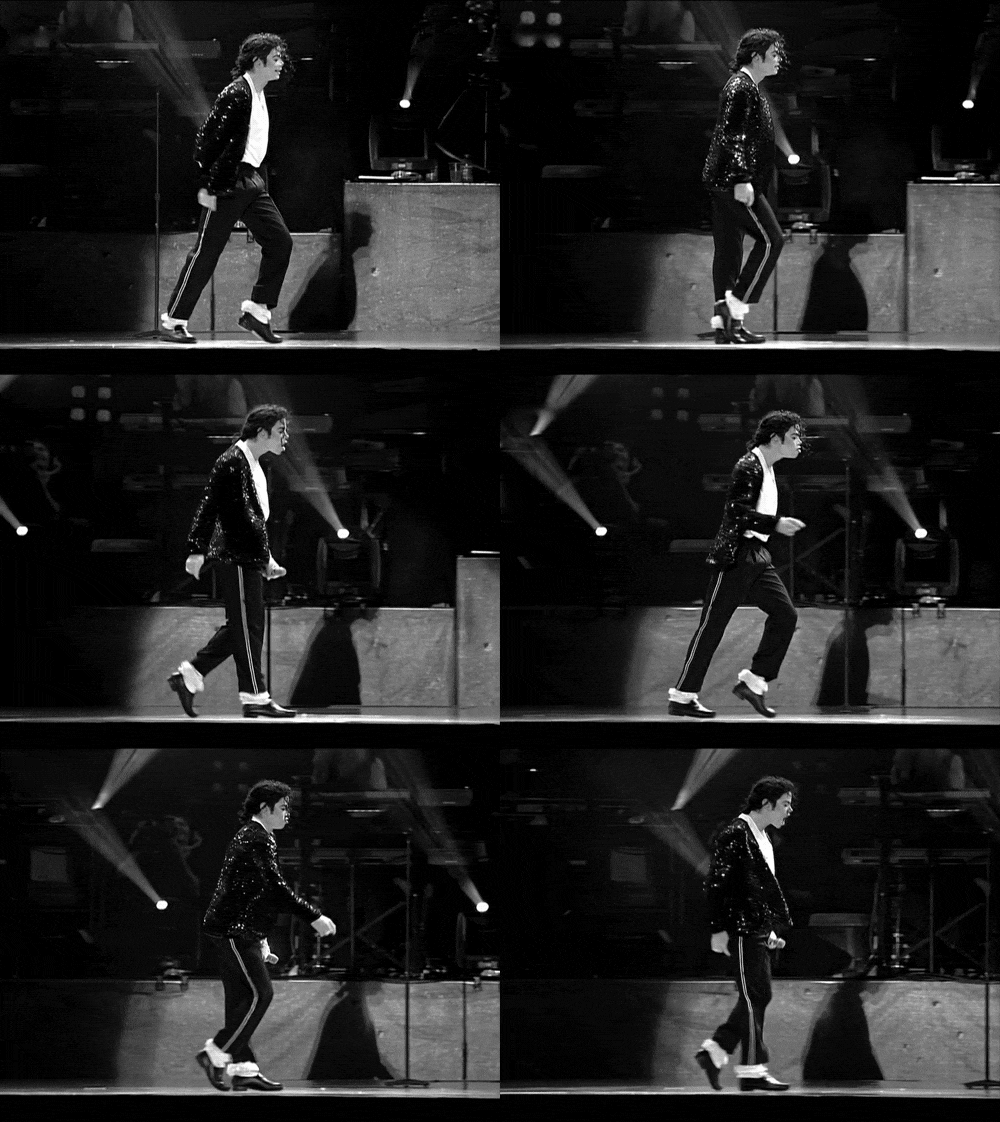
According to several sources, MTV helped give rise to pop stars such as Michael Jackson and Madonna; and Jackson and Madonna helped make MTV. Pop music has been dominated by the American and (from the mid-1960s) British music industries, whose influence has made pop music something of an international monoculture, but most regions and countries have their own form of pop music, sometimes producing local versions of wider trends, and lending them local characteristics. Some of these trends (for example Europop) have had a significant impact of the development of the genre. According to Grove Music Online, "Western-derived pop styles, whether coexisting with or marginalizing distinctively local genres, have spread throughout the world and have come to constitute stylistic common denominators in global commercial music cultures". Some non-Western countries, such as Japan, have developed a thriving pop music industry, most of which is devoted to Western-style pop, has for several years produced a greater quantity of music of everywhere except the USA.The spread of Western-style pop music has been interpreted variously as representing processes of Americanization, homogenization, modernization, creative appropriation, cultural imperialism, and/or a more general process of globalization.HIStory - Past, Present And Future - Book I was Michael Jacksons 9th studio album and first published in June 1995. It also included the first official called greatest hits compilation on Epic records. It sold over 40 million times worldwide and was therefore commercially less successful than his predecessor 'Dangerous'.
Only one number 1 hit in the United States (You Are Not Alone) makes the statistics look pretty bad. But as so often before, Michael at this time was less measured by his music but by the stories who went through the press. In addition, the songs were timeless and did not fit right into the current chart music. Years later songs like 'They Don't Care About Us' were properly recognized and regarded as masterpieces.
HIStory showed for the first time also "another face" of Michael Jackson. Lots of hate and anger are noticeable in some songs. What is also reflected in the vocabulary of some songs. The cause is naturally centered primarily on the allegations levied against him in 1993.
HIStory - Past, Present And Future - Book I was the second last studio album in whose publication Michael was involved.



No hay comentarios:
Publicar un comentario